In every business boardroom, there has always been one common question: “What is the real picture?”
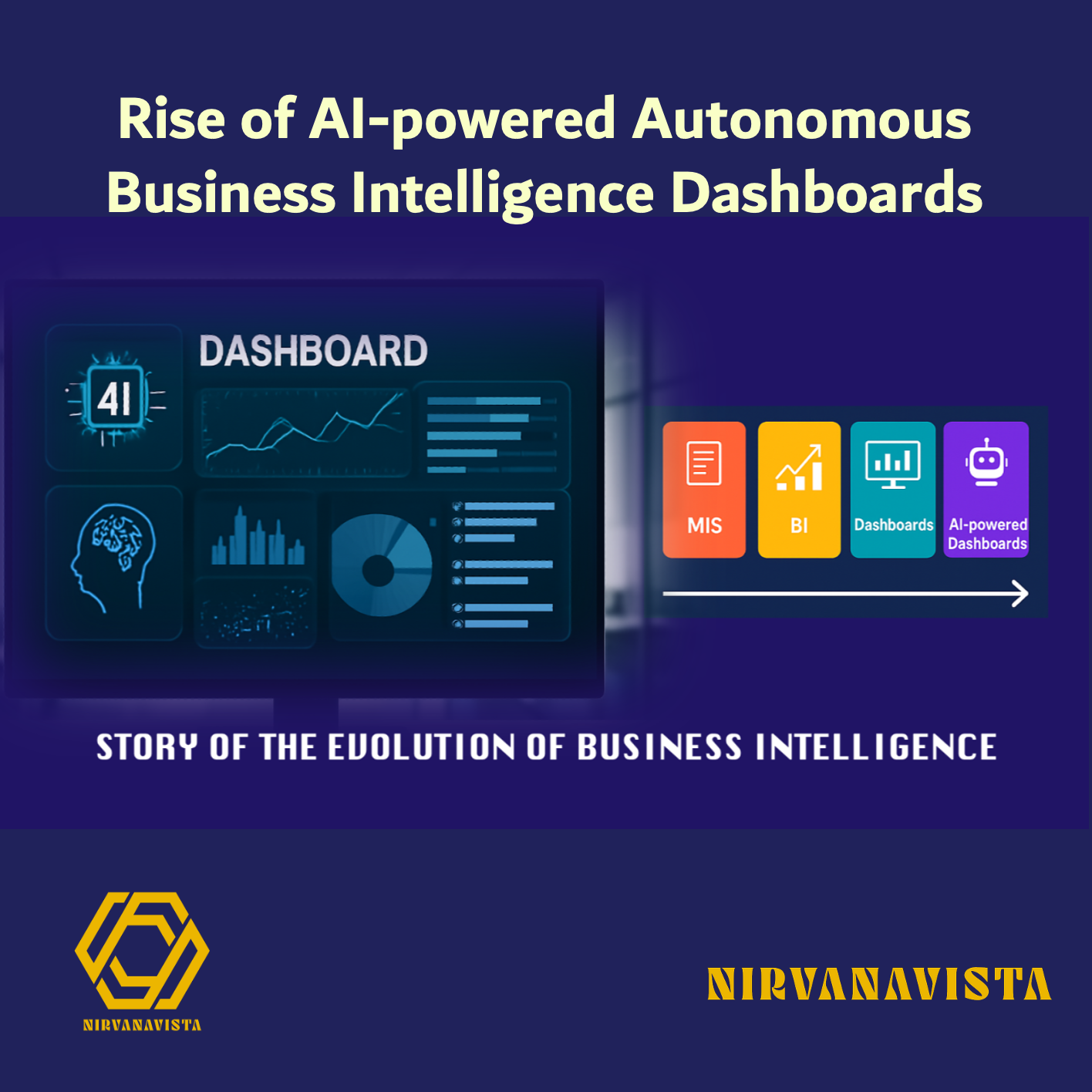
From the earliest days of Management Information Systems (MIS) to the cutting-edge world of autonomous, AI-powered dashboards, the story of business intelligence has been nothing short of transformational.
🌱 Evolution of MIS
The story began with the early use of punch cards in the 1800s, evolving through centralised mainframe systems of the 1960s. The rudimentary management information system supported management decisions with data generated primarily by accounting departments, running on massive IBM machines. The 1970s witnessed decentralisation as businesses adopted personal computers, giving rise to departmental autonomy in data processing. The proliferation of the internet in the 1980s further decentralised information, leading to creation of roles like the Chief Information Officer (CIO) to oversee disparate systems. By the late 1990s, enterprise-wide systems and cloud-based platforms blurred the lines between information producers and consumers, ushering an era where virtually every employee got empowered to make data-driven decisions.
MIS was actually the beginning – a structured way for organizations to collect, process, and distribute data. In its early days, MIS primarily meant static reports – sales summaries, expense statements, stock movement summaries, inventory status, scheme performance or performance reviews against static KPIs. However accurate and revealing, these reports were essentially backward-looking – helpful, but reactive.
Businesses evolved as did the markets and the consumers. In the new, more complex business scenarios global leaders needed more than snapshots. They needed context, trends and insights. This demand gave birth to Business Intelligence (BI) – a definitive leap forward that turned raw data into structured, multi-dimensional and ‘queryable’ information. BI tools enabled decision-makers to slice and dice data, discover patterns and build strategies based not just on numbers, but on insights that these data visualisations drove.
🚀 Business Intelligence: From Data Aggregation to Insights
Incidentally, the fundamental concept of Business Intelligence (BI) dates back to the 19th century, when Richard Millar Devens used the term to describe strategies to achieve competitive advantage using business data. BI largely remained a manual process until the digital revolution of the 1950s and 1960s, when IBM and others introduced digital storage and database management systems. The development of the relational database by Ted Codd set the foundation for structured querying and meaningful insights. The earliest BI systems involved data aggregation, storage and reporting and was primarily driven and controlled by the IT departments. Subsequently, the self-service era arrived, as tools evolved, empowering business analysts to perform ad-hoc analysis, identify patterns and visualize multidimensional data through intuitive dashboards. This transformation accelerated decision-making and enabled organisations to compete more effectively.
To be honest, the digital economy ushered in a new business expectation – speed. Organisations was no longer ready to wait for monthly or even weekly reports. The need was for insights in real time. Dashboards emerged as the interface between humans executives and data: colourful charts, interactive reports, drill-down capabilities, agile and real-time visual insights.
The dashboard was not just a display, it became the virtual cockpit and control panel of the modern business. Now, as data sources and volumes exploded – myriad sources, millions of transactions, social media feeds, IoT signals, etc. – dashboards were left with no choice but to evolve once again.
🤖 Rise of Autonomous, AI-Powered Dashboards
As the volume, the velocity and the complexity of business data outpaced traditional analysis, the next leap was fuelled by artificial intelligence, machine learning models and powerful autonomous AI agents. Intelligent business dashboards today use autonomous learning models to automate data collection, analysis, and visualisation. Advanced platforms deliver predictive analytics, real-time KPI tracking and actionable insights through intuitive interfaces accessible across devices. These AI-powered dashboards transform every possible industry from manufacturing, healthcare, finance and retail to IT operations of government organisations as well as mammoth public sector enterprises. They assist and often autonomously power optimisation of enterprise resources, help in adroit allocation, support proactive decision-making and enhance strategic agility. Autonomous learning models adapt dynamically to business conditions, making recommendations and surfacing opportunities that were previously unidentified or undetectable using manual methods. The future is even more exciting as it points to further integration with technologies like IoT and 5G, promising even higher operational efficiency and strategic contribution.
The business world today, is entering into the era of self-learning business dashboards. Powered by AI and ML, these dashboards don’t just report what has already occurred – they predict what, by all probabilities is about to happen. The key aspects of this era of agile and predictive business intelligence, as I understand, will be but not limited to the following:
- Autonomous monitoring: Dashboards that automatically and autonomously detect anomalies – say, a sudden drop in sales or online conversions or optimum stock level at a given stock point and alert managers accordingly, in real-time in the form of intelligence snippets, anomaly feed or deviation red-flags.
- Prescriptive intelligence: Beyond describing and predicting, dashboards that recommend actions – for example, suggesting adjustments in ad spend to maximise ROI or suggesting changes in stock replenishment strategies or in pointing to efficient set of suppliers and compliant vendors, etc.
- Conversational analytics: Self-learning bots being part of dashboards, that can handle user questions like “What were the last quarter’s top revenue drivers?”. The answers would be delivered instantly, often visually. Dashboards are expected to move beyond one language and become multi-lingual, allowing text-to-speech and speech-to-text conversions, linguistic translations and transliterations.
- Continuous learning: Such systems will get smarter with every query, every decision, every dataset – learning the nuances of the business and evolve muck like a human analyst.
The business intelligence dashboards has stopped being just a tool. It has become an extended intelligent business arm, a thinking partner – supporting and augmenting human decision-making, autonomously, with machine precision and foresight.
📊 Key Milestones
Image: The Journey of BI
🌍 The World Ahead of Us
The evolution from MIS to BI to AI-powered dashboards reflects a larger shift: from data as a record, to data as intelligence, to data as action.
- Leaders are no longer forced to navigate blindfolded – they are assisted by predictive copilots.
- Businesses are no longer expected to be reactive – they can be proactive, even anticipatory.
- Decisions are no longer the sole child of human intuition, driven by backward looking data – they are hybrid judgments, where human wisdom meets artificial intelligence learning.
Tighten your seat-belts. The ride isn’t over. As the story unfolds, the next frontier is autonomous and intelligent enterprises, where dashboards will seamlessly integrate with workflows and systems to execute decisions automatically – optimising supply chains, adjusting marketing campaigns, making intelligent choices, reallocating resources and designing mitigation strategies, autonomously, in real time.
The question then will no more be: “What’s happening with the business?”
Rather it will be: “What’s one doing about it – right here, right now?”
And the most exciting part? We are going through just the initial chapters, as the real story unfolds.
💬 Couple of Questions for MSME entrepreneurs and business owners to ponder upon –
Question 1: What’s your biggest bottleneck in enterprise decision-making OR Data silos OR Analysis paralysis OR execution lag OR all of them?
Question 2: How is your organisation reducing decision latency or building enterprise-wide autonomous business intelligence frameworks?
Happy to discuss and share our experience in delivering AI-powered applications, services, insights and decision making platforms to large enterprises, government organisations and SME enterprises. Happy to respond to your queries and connect with enterprises to help them adopt intelligent and autonomous framework of business intelligence, to devise pro-active, intuitive and anticipatory actions of critical business importance. NirvanaVista Consultants Pvt. Ltd. is happy to assist MSMEs in building their intelligent and autonomous AI-powered frameworks.